FM and Angle Modulation · Volume 2
FM & Angle Modulation — Vol 2: Why Anyone Put Up With It
FM costs you bandwidth, complexity, and infinite sidebands. What it buys is a limiter that throws lightning away, an amplifier that doesn't have to be linear, and a channel that is either perfect or silent.
2.1 The limiter throws the noise away
Volume 1 made FM look like a bad deal. A 16 kHz signal to carry 3 kHz of speech, where SSB does it in 2.4 kHz. Sidebands running off to infinity. Bessel functions. Why would anyone bother?
Because of one circuit and one consequence.
Almost all the noise that ruins a radio signal is amplitude noise. Lightning crashes, arcing power-line insulators, the neighbour’s LED floodlight, ignition noise, the hash from a cheap switching supply — these are all fundamentally amplitude disturbances riding on top of whatever you are trying to hear. An AM receiver has no defence, because an AM receiver’s entire job is to follow amplitude. It demodulates the static as faithfully as it demodulates the voice. Anyone who has listened to AM broadcast during a summer thunderstorm knows exactly what that sounds like.
An FM receiver has a limiter: a stage deliberately driven into hard saturation, which clips every incoming signal to a constant amplitude before the detector sees it. All amplitude information is destroyed — flattened, thrown away — and the FM signal does not care, because its information is not in the amplitude. The constant-envelope property from Volume 1 stops being a curiosity and becomes the whole point: an FM signal is unharmed by the operation that annihilates the noise.
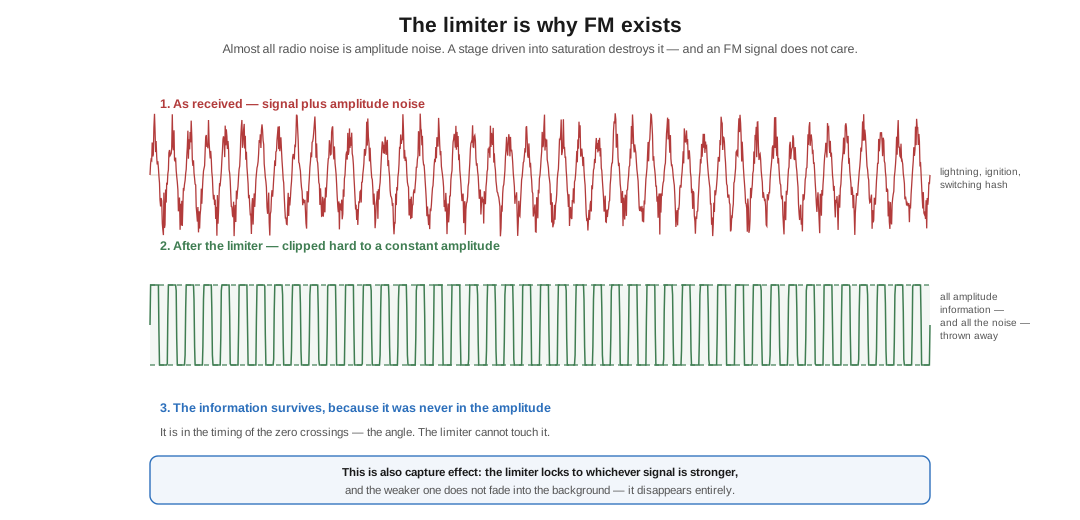
The result is the thing that made FM famous: a strong FM signal is quiet. Not “less noisy” — quiet, with a black silence behind it, in the middle of weather that would make an AM channel unusable. Edwin Armstrong demonstrated this in the 1930s against an industry that had every commercial reason not to want to hear it, and the whole miserable history of what happened to him afterwards is a story for another dive.
2.2 Capture effect: the strongest signal wins outright
The second consequence follows from the same property, and it is the one that shapes how VHF operating actually feels.
Put two AM signals on the same frequency and you hear both, mixed together, fighting. The stronger one dominates but the weaker is audibly there, and if they are comparable you get a heterodyne whistle and an unintelligible mess. Two AM stations share a channel badly but they share it.
Put two FM signals on the same frequency and something quite different happens. The limiter locks onto whichever signal is stronger, and the detector follows only that one. The weaker signal does not merely fade into the background — it disappears completely. This is the capture effect, and the capture ratio of a decent receiver is only a few dB. Ten percent stronger and you own the channel outright.
Every VHF operator knows the behaviour even if they have never heard the term:
- Two stations doubling on a repeater input does not produce two garbled voices. It produces one clean voice and a faint buzz, and the other station simply is not there.
- Driving through a valley, an FM signal does not degrade gracefully the way SSB does. It is perfect, perfect, perfect, then a burst of hiss, then nothing. The cliff effect.
- A weak intermittent signal is worse on FM than on SSB. If I can hear a station at all on SSB, no matter how badly, I can usually dig a callsign out of it. Below the FM threshold there is nothing to dig — the limiter has thrown away the very amplitude information that would have let me.
This is the honest trade. FM is better than SSB above the threshold and useless below it. Which is exactly why the VHF/UHF world is split the way it is: FM for local work through repeaters where signals are strong and convenience matters, and SSB and CW for weak-signal work where every last decibel counts.
2.3 The amplifier gets to be cheap
There is a third benefit, and it is the one that quietly decided FM’s place in commercial radio.
An SSB or AM signal has information in its envelope, so every amplifier stage that touches it must be linear — it must reproduce that envelope faithfully. Linear amplifiers are biased into class A or AB, which means they conduct through most or all of the cycle, dissipate a great deal of heat, and are perhaps 30–50% efficient. They also need careful adjustment, and if you overdrive one you generate intermodulation distortion and splatter across your neighbours.
An FM signal has a constant envelope, so there is no envelope to preserve. You can run it through a hard-switching class C amplifier, or a class D or E stage, which barely resembles a linear amplifier at all and reaches 70–80% efficiency or better. Simpler, cooler, cheaper, no linearity adjustments, and it does not splatter when overdriven because there is nothing to overdrive.
For a handheld radio that has to live on a battery, that efficiency difference is decisive. It is a substantial part of why the entire commercial land-mobile world — police, fire, taxi, business radio — went FM and stayed FM for sixty years, and why the 2 m handheld in my go-bag is the size it is.
2.4 Narrowband and wideband: two different design targets
The same modulation, aimed at two different goals.
Wideband FM (WBFM) spends bandwidth to buy fidelity. Broadcast FM deviates ±75 kHz, carries audio to 15 kHz, occupies about 180 kHz by Carson’s rule and is allocated a 200 kHz channel. All that spectrum buys stereo, a subcarrier for RDS, and genuinely high-fidelity sound. The improvement in signal-to-noise ratio from FM rises with modulation index, so a high index is not waste — you are trading bandwidth for quieting, deliberately.
Narrowband FM (NBFM) spends bandwidth on nothing at all, because there is none to spend. Amateur and land-mobile NBFM deviates about ±5 kHz, carries speech to 3 kHz, and fits in 16 kHz — designator 16K0F3E. It still gets the limiter, still gets capture effect, still gets the cheap amplifier; it just does not get the fidelity. It is a communications mode, not a music mode. (And the land-mobile world has since been forced narrower still — “narrowbanding” mandates pushed commercial users to ±2.5 kHz deviation in 12.5 kHz channels, with a matching loss of audio quality that every user complained about and every regulator overruled.)
Set an NBFM receiver on a WBFM signal and you get horrible distortion, because the signal swings clean outside your filter. Set a WBFM receiver on an NBFM signal and you get a weak, quiet, muffled result, because you are only using a fraction of the detector’s range. Neither is broken; they are simply two different agreements.
2.5 The 2 m world in practice
FM’s real amateur home is VHF and UHF, and a few practical details define daily operating there.
Repeaters exist because FM’s cliff behaviour and VHF’s line-of-sight propagation both reward height. A repeater sits on a tower or a hill, listens on one frequency and retransmits on another simultaneously, and turns a handheld’s two watts into county-wide coverage. The two frequencies are separated by a standard offset — conventionally −600 kHz on 2 m in the US and ±5 MHz on 70 cm — and a duplexer, a set of very sharp cavity filters, is what lets one antenna transmit and receive at once without the transmitter deafening the receiver.
CTCSS — Continuous Tone-Coded Squelch System, and everybody calls it by Motorola’s trade name, PL for Private Line — is a sub-audible tone, in the 67 to 250 Hz range, transmitted continuously beneath the voice. The repeater will not open unless it hears the right tone. It is not security and never was; it is a filter against distant co-channel repeaters opening on each other during a band opening, and against noise keying the machine up. DCS is the digital equivalent, a continuously repeating low-rate code instead of a tone.
Squelch itself is the small mercy that makes FM liveable. Because an unmodulated FM channel with no signal produces full-blast white noise from the detector, every FM receiver includes a circuit that mutes the audio until a signal appears. Set it just past where the hiss stops. Set it too tight and you will sit in silence while somebody calls you.
That is the analogue world, complete: amplitude in the previous dive, angle in this one. Every mode from here forward is built out of the same three knobs — but grabbed abruptly, in discrete steps, by a machine. That is shift keying, and it starts with the oldest mode in this project.
2.5.1 Sources (Vol 2)
- H. Ward Silver, N0AX, “Wireless Modes — Part 1,” Nuts & Volts, March 2017 — the FM receiver responding only to frequency variation and therefore rejecting AM static, and the constant-envelope property permitting simpler, more efficient non-linear amplifiers. https://www.nutsvolts.com/magazine/article/March2017_HamsWirelessWorkbench_Wireless-Modes
- ARRL Handbook / Radio Technology Portal, FM and repeaters chapters — limiters, capture effect, threshold and quieting, NBFM deviation practice, repeater offsets, CTCSS/DCS and squelch. https://www.arrl.org/tech-portal
- Broadcast FM parameters (±75 kHz deviation, 15 kHz audio, 200 kHz channel spacing) and the Carson-rule 180 kHz figure — see FM & Angle Modulation Vol 1 sources.
- Amplifier efficiency figures are the standard class-A/AB versus class-C/D/E ranges given in any RF power amplifier text; the exact numbers depend heavily on the design. ⟨treat as orders of magnitude, not specifications⟩
- CTCSS tone range and the “PL” trade name (Motorola), and the US land-mobile narrowbanding mandate to 12.5 kHz channels — ⟨verify current requirements against the FCC before relying on them⟩
- Cross-links: The Shift-Keying Family (where the knobs start being grabbed digitally); RTTY on the Air (AFSK over an FM link, the 1,000 Hz VHF shift); Building a Wireless-Modes Bench (hearing capture effect and the cliff for yourself).