Weak-Signal Modes and FT8 · Volume 1
Weak-Signal Modes & FT8 — Vol 1: The Nobel Laureate Who Rewrote Ham Radio
Joe Taylor pulled a binary pulsar out of the noise and won a Nobel Prize for it. Then he applied the same mathematics to a callsign, and on 29 June 2017 — weeks after this sub-project's seed article went to press — changed amateur radio more than anything since SSB.
1.1 The gap at the end of the article
The two Nuts & Volts columns that seeded this sub-project end well. Ward Silver signs off Part 2 with a fair prediction — that digital modes will keep multiplying, that software-defined radio will accelerate it, and that Morse is not going anywhere. Everything he says is right.
And then there is a hole in the page where the biggest thing should be, through no fault of his whatsoever. Part 2 ran in the May 2017 issue. FT8 was released on 29 June 2017 — weeks later. Within two years it was the most-reported mode on the automatic spotting networks, and today, on a given evening, there are more amateurs working FT8 than every other mode on the HF bands combined.
I have mixed feelings about that, and I will get to them honestly in Volume 2. But it happened, it happened in the gap between Ward’s last paragraph and now, and this dive is the one the seed articles could not write.
1.2 From a pulsar to a callsign
The story starts a long way from a radio shack, and it starts with two teenage brothers on the VHF bands.
Joe Taylor, K1JT, and his brother Hal were licensed as boys and spent their time chasing marginal VHF contacts — scatter propagation, signals right at the edge of readability, the kind of operating where you spend an hour to confirm one callsign. That is not a hobby detail I am including for colour. It is the whole biography, because the problem of extracting a real signal from a great deal of noise turned out to be Joe Taylor’s career.
He went into radio astronomy. In 1974, working with his graduate student Russell Hulse at the Arecibo telescope, he found something in the data that should not have been there: a pulsar whose pulse period was itself varying, periodically. PSR B1913+16 was a pulsar in a tight binary orbit with another neutron star — and its orbit was measurably decaying, at precisely the rate general relativity predicts if the system is radiating away energy as gravitational waves. It was the first evidence that gravitational radiation exists. Hulse and Taylor shared the 1993 Nobel Prize in Physics for it.
Gravitational waves were finally detected directly by LIGO on 14 September 2015, announced in February 2016 — which is the “detected directly just last year” that Ward refers to in his article, and which puts a nice date stamp on when he was writing.
Now hold the two halves of that biography together. Finding a periodic signal buried far below the noise, by knowing exactly what shape to look for and integrating long enough to find it, is the same problem in both careers. A pulsar and a callsign are, mathematically, remarkably similar things to dig out of a noisy sky. When Taylor turned his attention back to amateur radio in the late 1990s, he brought professional-grade detection theory with him, and the results were named after him: the WSJT family, Weak Signal / Joe Taylor.
1.3 The bargain: what you give up to hear the inaudible
Every weak-signal mode in this family makes the same trade, and understanding it explains everything that follows — including why people find these modes unsatisfying.
You give up freedom of message. A conventional mode lets you send whatever you like. These modes do not. FT8 messages are a fixed, tiny set of structures: a callsign, a grid square, a signal report, an acknowledgement, a farewell. The whole payload is 77 bits. That is not a limitation the designers regret — it is the source of the power. If the receiver already knows the message must be one of a constrained set, it does not have to identify arbitrary text; it only has to decide which of the possible messages best fits what arrived. That is a vastly easier problem.
You give up speed. Sensitivity is bought with time. Spread a message over a longer interval and the decoder integrates over more of it, and coherent integration beats noise: signal adds proportionally to time, noise adds only as the square root. FT8 spends 12.64 seconds transmitting to convey 77 bits — about 6 bits per second. A 1980s modem was three hundred times faster.
You give up spontaneity. These modes are rigidly time-synchronised. FT8 transmits in the first 15 seconds of every quarter-minute, and every station on the band starts and stops together, on the second. Your computer’s clock must be right to within about a second — usually within a fraction of one — which in practice means running NTP. A station with a wrong clock is invisible to everyone.
What you buy is sensitivity. FT8 decodes reliably at about −21 dB signal-to-noise ratio, measured in a 2500 Hz reference bandwidth. Think about what that number means. The signal is roughly one hundred and twenty-fifth the power of the noise in the same bandwidth. There is nothing to hear. You can turn the volume up as far as you like and there is no tone, no rhythm, no hint — and the software prints a callsign, a grid square, and a signal report.
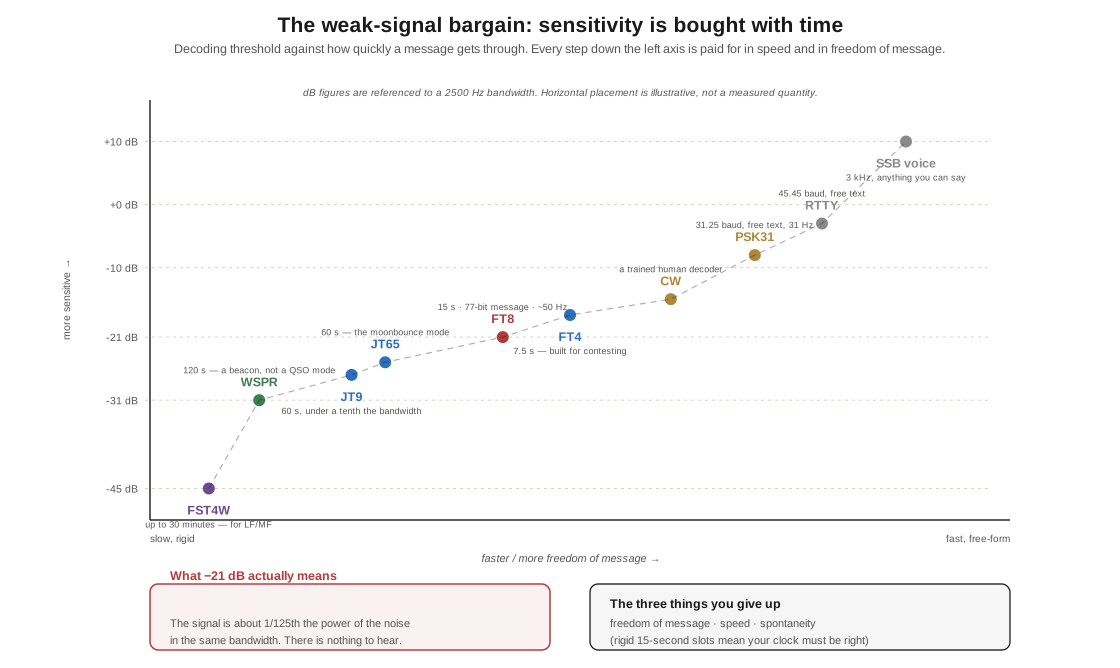
For scale: a competent CW operator copies at roughly −15 dB in the same reference bandwidth, and SSB needs about +10 dB. CW’s reputation for punching through is entirely deserved — it beats SSB by about 25 dB — and FT8 beats CW by another 6 dB or so, with JT65 and WSPR further down still.
1.4 The ladder: JT65 → JT9 → FT8
The family did not arrive all at once.
JT65 (2003) was built for moonbounce — bouncing a VHF signal off the Moon, which costs about 250 dB of path loss and had previously demanded enormous antenna arrays and a great deal of patience. JT65 uses 65 tones, a one-minute transmit/receive cycle, and Reed–Solomon error correction, and it decodes at around −25 dB. It made EME achievable with a modest station, and it is still the mode people associate with the Moon.
JT9 (2012) aimed the same techniques at HF. Its JT9A submode is about 1 dB more sensitive than JT65 in less than a tenth of the bandwidth — roughly 16 Hz wide, narrow enough that a great many signals fit in one SSB channel. Also one-minute cycles.
Both worked, and both had the same complaint against them: a minute per transmission. A complete QSO is six transmissions, so it took five or six minutes to exchange callsigns and reports. On a fleeting band opening, the opening closes before you finish.
FT8 — Franke–Taylor 8-FSK, for Steve Franke K9AN and Joe Taylor — was the answer, released 29 June 2017. Its design is worth spelling out, because every number in it is doing a job:
Table 1 — FT8 — Franke–Taylor 8-FSK, for Steve Franke K9AN and Joe Taylor — was the answer, released 29 June 2017. Its design is worth spelling out, because every number in it is doing a job
| Parameter | Value | Why |
|---|---|---|
| Modulation | 8-FSK (GFSK-shaped) | 3 bits per symbol; constant envelope |
| Tone spacing | 6.25 Hz | equal to the symbol rate — the minimum for orthogonality |
| Symbol rate | 6.25 baud | 0.16 s per symbol; long symbols integrate well |
| Symbols per transmission | 79 | 79 × 0.16 s = 12.64 s |
| T/R period | 15 s | 12.64 s transmitting, the rest to decode and turn around |
| Occupied bandwidth | ~50 Hz | 8 tones × 6.25 Hz — narrower than PSK31 |
| Payload | 77 bits | ~13 free-text characters, or a structured message |
| Error control | LDPC(174,91) + 14-bit CRC | modern capacity-approaching FEC |
| Threshold | ≈ −21 dB (2500 Hz ref) | a few dB less sensitive than JT65 |
FT8 is deliberately a few decibels less sensitive than JT65 and four times faster. That is the entire product decision, and it was the right one: a complete contact in about a minute instead of six, at a sensitivity still far below anything a human ear can do. Trading a little sensitivity for a great deal of speed is what took the mode from “clever” to “everywhere.”
1.5 What a QSO looks like
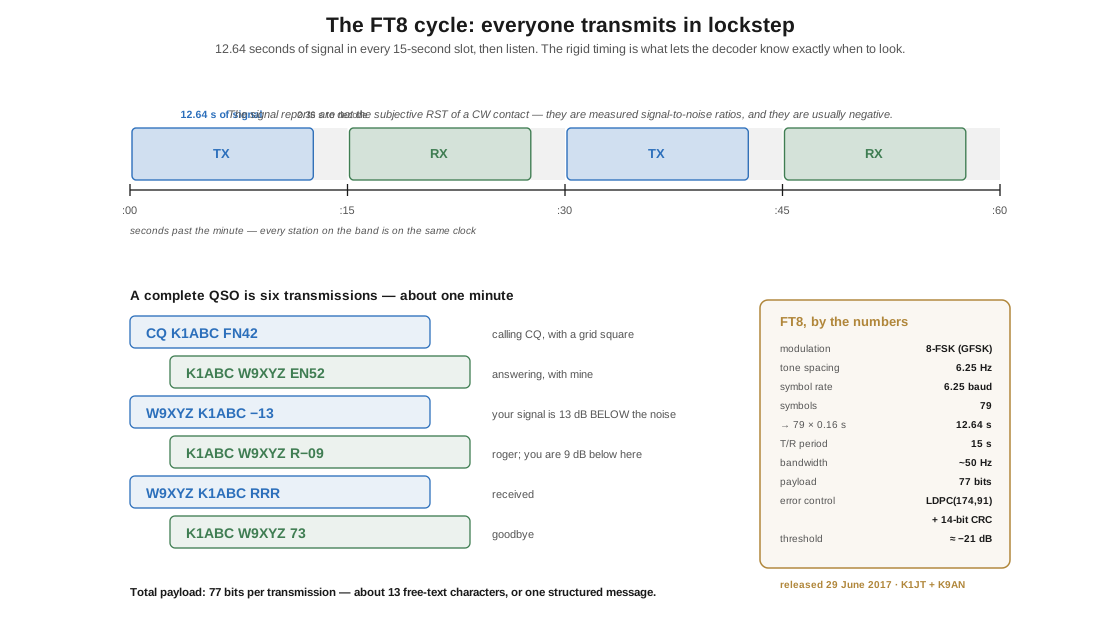
Six messages, and the software will run all of them for you if you let it:
  CQ K1ABC FN42            ← calling, with grid square
  K1ABC W9XYZ EN52         ← answering, with mine
  W9XYZ K1ABC -13          ← your signal is 13 dB below the noise
  K1ABC W9XYZ R-09         ← roger; you're 9 dB below here
  W9XYZ K1ABC RRR          ← received
  K1ABC W9XYZ 73           ← goodbye
Note the signal reports. They are not the subjective RST of The Code, Timing & Abbreviations — no “599” reflex here. They are measured signal-to-noise ratios in decibels, computed by the decoder, and they are usually negative. −13 means the signal was thirteen decibels below the noise floor in a 2500 Hz bandwidth. There is something honest about a mode whose signal report is a measurement, and something a little cold about it too.
Volume 2 covers the rest of the family — the beacon mode, the meteor mode, the Moon mode, the one that gives you your free text back — and then makes the argument about whether any of this is really operating.
1.5.1 Sources (Vol 1)
- H. Ward Silver, N0AX, “Wireless Modes — Part 2,” Nuts & Volts, May 2017 — the “A Nobel Effort” sidebar (Joe Taylor K1JT and his brother Hal as teenage VHF scatter operators, the Hulse–Taylor binary pulsar, the WSJT modes, and gravitational waves “detected directly just last year”). 🔴 This dive exists because the article closes in May 2017 and FT8 was released the following month. https://www.nutsvolts.com/magazine/article/wireless-modes-part-2
- 🔴 FT8: released 29 June 2017 by Joe Taylor K1JT and Steve Franke K9AN; 8-FSK, 77-bit message payload, 12.64 s of transmission in a 15-second T/R period, decoding threshold −21 dB in a 2500 Hz reference bandwidth, ~6.09 bit/s. https://en.wikipedia.org/wiki/FT8 (→ its citations, principally Franke, Somerville & Taylor, “The FT4 and FT8 Communication Protocols,” QEX, Nov/Dec 2020). The 6.25 Hz tone spacing / 6.25 baud symbol rate follows from 79 symbols × 0.16 s = 12.64 s.
- WSJT-X User Guide (K1JT et al.) — FT8 as “four times faster (15-second T/R sequences) and less sensitive by a few dB” than JT65; JT9A “1 dB more sensitive than JT65 while using less than 10% of the bandwidth”; WSPR decodable “at signal-to-noise ratios as low as −31 dB in a 2500 Hz bandwidth”; FST4/FST4W reaching “as low as −45 dB.” https://wsjt.sourceforge.io/wsjtx-doc/wsjtx-main-2.6.1.html
- Hulse–Taylor: PSR B1913+16, discovered 1974 at Arecibo; 1993 Nobel Prize in Physics to Russell A. Hulse and Joseph H. Taylor Jr. LIGO’s first direct detection was 14 Sept 2015, announced 11 Feb 2016.
- ⚠ The comparative thresholds for CW (≈ −15 dB) and SSB (≈ +10 dB) in a 2500 Hz reference are the figures customarily quoted in WSJT documentation and ARRL articles; they depend on the operator and on what counts as “copy.” ⟨treat as approximate — they are a scale, not a specification⟩
- Cross-links: Morse & CW → Learning & Operating CW (the human decoder, and the RST report FT8 replaces with a measurement); The Shift-Keying Family (MFSK and FEC, of which this is the sophisticated end).