How a Signal Carries Information · Volume 2
How a Signal Carries Information — Vol 2: What a Mode Actually Is
Modulation is only a third of the answer. A mode is information plus an air link plus a protocol — and in January 2024 the FCC quietly changed the rules about what American hams are allowed to build out of those parts.
2.1 Modulation is not enough
Volume 1 ended with modulation: vary the amplitude, frequency, or phase of a carrier and you can put information on it. That is true and it is necessary, and it is nowhere near sufficient.
Suppose I hand you a receiver and tell you a signal is out there carrying a text file. You still cannot read it. You need to know what frequency to listen on. You need to know which of the three properties is being varied, and by how much, and how fast. You need to know what the variations mean — is a shift up a “1” or a “0”? You need to know how the characters are coded into bits in the first place. And then, even with every bit correctly received, you need to know the rules of the conversation: how a session gets started, who talks when, what happens when a block arrives corrupted, how you know the file has ended.
Ward Silver’s framing of this in the seed article is the best short definition I know, and I have adopted it wholesale for this sub-project. A mode has three parts:
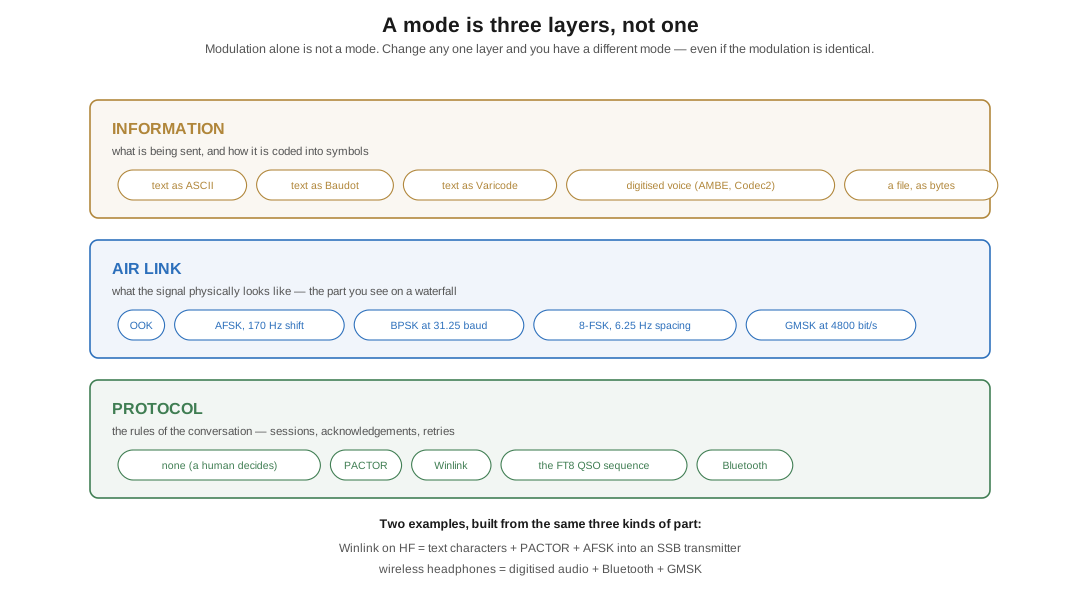
- The information — what is being sent, and how it is encoded into symbols. Text as ASCII. Text as Baudot. Text as Varicode. Digitised speech as an AMBE or Codec2 bitstream. A file as raw bytes.
- The air link — everything about the physical signal. Modulation type, bandwidth, symbol rate, tone spacing, filtering. This is the part you can see on a waterfall and the part the FCC writes rules about.
- The protocol — the rules of engagement. Handshaking, addressing, acknowledgements, retries, error correction, how a session opens and closes.
All three, together, are what hams call a mode. Get any one of them wrong and nothing works, which is why “I can see the signal but I can’t decode it” is such a common and such a specific complaint.
The examples make it concrete. If I want to send a text file over HF using Winlink, the mode is: text characters (the information) + PACTOR (the protocol, which handles acknowledgements and retries) + AFSK audio into an SSB transmitter (the air link). Three separate choices. Meanwhile in the living room, my wireless headphones are running digitised audio (information) + Bluetooth (protocol) + GMSK (air link) — a completely different mode, built the same way out of the same three kinds of part.
And here is the point that makes the framework worth having: two modes can share a layer and still be entirely different modes. RTTY and one flavour of Winlink both use AFSK. They are not remotely the same thing, because the other two layers differ. Conversely PSK31 sent by a $2,000 transceiver and PSK31 sent by a Raspberry Pi with a $20 sound card are the same mode, because all three layers match, and the two will talk to each other perfectly.
2.2 The FCC calls it an emission
Regulators cannot work with a word as loose as “mode.” To write an enforceable rule you need to say precisely what a signal is, and so the ITU and the FCC use emission designators — a compact code that describes the necessary bandwidth and the character of a signal.
The core of a designator is three characters, optionally preceded by a bandwidth field and followed by two more characters of detail:
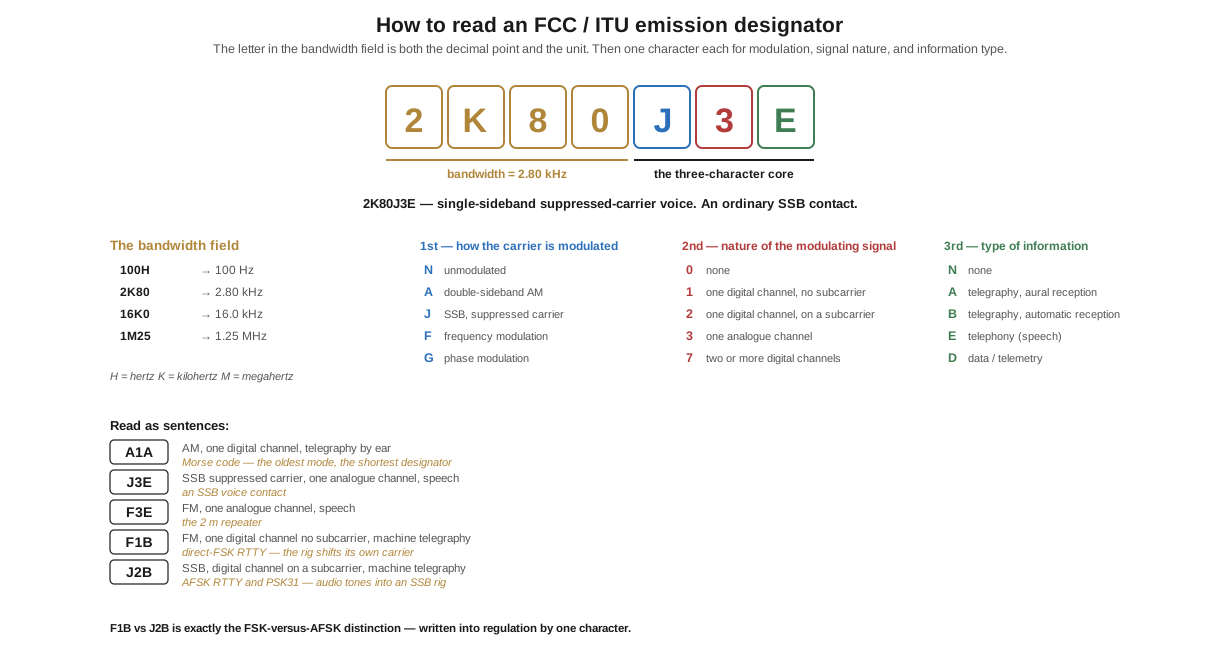
The bandwidth trick is the elegant part: the letter is the decimal point and the unit. 2K80 means 2.80 kHz. 20K0 means 20.0 kHz. 100H means 100 Hz. 1M25 means 1.25 MHz. Once you have seen it you never misread one again.
Then the three character positions:
Table 1 — Then the three character positions
| Position | Means | Common values |
|---|---|---|
| 1st | How the carrier is modulated | N unmodulated · A double-sideband AM · J single sideband, suppressed carrier · F frequency modulation · G phase modulation |
| 2nd | Nature of the modulating signal | 0 none · 1 single digital channel, no subcarrier · 2 single digital channel using a subcarrier · 3 single analogue channel |
| 3rd | Type of information | N none · A telegraphy for aural reception · B telegraphy for automatic reception · E telephony (speech) · D data · F video |
So the designators a ham actually meets read like sentences once you know the grammar:
A1A— amplitude modulated, one digital channel with no subcarrier, telegraphy meant to be copied by ear. That is Morse code: on-off keying, copied by a human. The oldest mode in this project has the shortest designator.J3E— single sideband suppressed carrier, one analogue channel, telephony. SSB voice. Usually written2K80J3Ein full.F3E— frequency modulation, one analogue channel, telephony. FM voice, the 2 m repeater.F1B— frequency modulation, one digital channel no subcarrier, telegraphy for automatic reception. Direct-FSK RTTY — the machine copies it, not a person, which is exactly what thatBis saying.J2B— single sideband, digital channel on a subcarrier, automatic telegraphy. AFSK RTTY and PSK31 through an SSB rig. The difference betweenF1BandJ2Bis precisely the FSK-versus-AFSK distinction from RTTY on the Air, written into regulation.
I find that last pair genuinely satisfying. A distinction that takes a paragraph of prose to explain to a new RTTY operator is captured exactly by one character position in a designator written in 1979.
2.3 The channel is why there are so many modes
A reasonable person, looking at the sheer number of amateur modes, might conclude the hobby has a standardisation problem. It does not. It has a channel problem, and the modes are the response.
A wire is a well-behaved thing. What you put in one end comes out the other, delayed and attenuated but essentially intact. The radio channel is nothing like that. The signal fades in and out as the ionosphere shifts. It arrives by several paths at once, at slightly different times, and the copies interfere with each other. It picks up lightning crashes, switching-supply hash, and the neighbour’s LED floodlight. If either station is moving, everything Doppler-shifts. And the character of all of this changes completely with frequency: 160 m at night is a different universe from 10 m at noon, and both are different from 2 m, and microwave is different again.
There is no mode that is best in all of those conditions, because the trade-offs genuinely conflict. Robustness costs speed. Narrow bandwidth costs the ability to spread across a fade. Heavy error correction costs throughput. So mode designers pick a target — this band, this kind of fading, this application — and optimise for it, and you end up with dozens of modes because there are dozens of situations.
This is the thread running through the rest of the sub-project. Every time we meet a new mode I will ask the same question: what channel was this designed for, and what did it give up to work there?
2.4 The rule that let hams invent, and the rule that changed in 2024
Until the mid-1990s, the FCC tried to evaluate and bless each new amateur digital mode individually. That does not scale, and it stopped. The rule became: within stated limits on bandwidth and broad modulation type, if the technical design of the mode is publicly documented, hams may use it. Publish the spec, and you may put it on the air.
That single change is why the amateur bands became a genuine laboratory. It is the reason PSK31 could go from one man’s idea to worldwide use, the reason FT8 could be released on a Thursday and be everywhere by autumn. It is also, incidentally, the reason proprietary modes are contentious — a mode you cannot document is a mode nobody can monitor, and open documentation is the price of the freedom.
But there was a second limit, and it was an old one. American HF data emissions were capped by a symbol rate — 300 baud on most HF segments, 1200 baud on part of 10 m. That number was written when a “symbol” meant roughly what it meant on a teletype, and by the 2010s it had become an accident of history that limited modes for no good engineering reason while placing no limit at all on the bandwidth a clever designer could occupy at 300 baud. Ward’s Part 2, in May 2017, noted the situation was “currently under evaluation by the FCC.”
It was resolved, and the article’s readers had to wait nearly seven years. In Report and Order FCC 23-93 (WT Docket No. 16-239), adopted 13 November 2023 and effective 8 January 2024, the Commission eliminated the symbol-rate limits on the affected HF bands and replaced them with a 2.8 kHz bandwidth limit — a number chosen because it is about what an SSB voice signal already occupies. The bands affected include 160, 80, 40, 30, 20, 17, 15, 12 metres and the 28.0–28.3 MHz segment of 10 m.
The philosophical shift is the interesting part. The old rule regulated how fast you could signal; the new rule regulates how much spectrum you may occupy — which is the thing that actually affects your neighbours on the band. It is a better rule, it took a long time, and it means a mode designed today has room to be cleverer than one designed in 2017.
⚠ A caution on rule citations. Regulations change, and a nine-year-old magazine article is proof of that. Anything in this project about what is legally permitted is a snapshot with a date on it. Before you build something and key it up, read the current Part 97 yourself. I have given the docket numbers precisely so you can go and check whether they have been superseded since I wrote this.
That is the framework. From here on, every dive is a specific set of answers to the three-layer question — starting with the oldest ones, where the property being varied is the simplest to grab: amplitude.
2.4.1 Sources (Vol 2)
- H. Ward Silver, N0AX, “Wireless Modes — Part 1” (Nuts & Volts, March 2017) and “Part 2” (May 2017) — the mode = information + air link + protocol framing, the Winlink/PACTOR/AFSK and Bluetooth/GMSK examples, the emission-designator concept, the radio-channel argument, and the mid-1990s deregulation. Part 2 is where the “currently under evaluation by the FCC” line appears. https://www.nutsvolts.com/magazine/article/March2017_HamsWirelessWorkbench_Wireless-Modes · https://www.nutsvolts.com/magazine/article/wireless-modes-part-2
- 🔴 FCC Report and Order FCC 23-93, WT Docket No. 16-239, “Amateur Radio Service Rules to Permit Greater Flexibility in Data Communications” — adopted 13 Nov 2023, effective 8 Jan 2024; eliminates the HF symbol-rate limitation and substitutes a 2.8 kHz bandwidth limit. https://docs.fcc.gov/public/attachments/FCC-23-93A1.pdf · Federal Register, 7 Dec 2023: https://www.federalregister.gov/documents/2023/12/07/2023-26770/amateur-radio-service-rules-to-permit-greater-flexibility-in-data-communications · ARRL summary: https://www.arrl.org/news/arrl-hails-fcc-action-to-remove-symbol-rate-restrictions
- Emission designator structure: ITU Radio Regulations Appendix 1 and 47 CFR §2.201, which define the bandwidth field notation and the three symbol positions. ⟨read the current CFR, not a hobby summary, before relying on a designator in anything official⟩
- Cross-links: RTTY on the Air (the
F1BvsJ2BFSK/AFSK distinction in the flesh), The Shift-Keying Family, Modern Digital & the Raspberry Pi (Winlink and the soundcard air link).